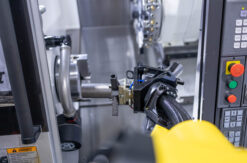
Boeing and Airbus together carry a combined commercial aircraft backlog of roughly 13,000 jets heading into 2026, equal to about 14 years of production at current delivery rates. That number tells the story of an industry stretched thin. The Federal Aviation Administration’s annual Aerospace Forecast tracks fleet expansion across general aviation, commercial carriers, and unmanned systems, all pointing to sustained demand for aircraft components built from increasingly difficult materials. As a result, the aerospace alloy milling machine has moved from a specialty purchase to a baseline requirement for shops competing in this market.
Furthermore, Tier 2 and Tier 3 suppliers face escalating quality requirements while OEMs push for shorter lead times. Meeting both demands requires equipment that handles high-temperature alloys, carbon-fiber composites, and the ultra-tight tolerances modern programs specify. Consequently, capital equipment decisions made over the next two years will determine which suppliers absorb the backlog work and which lose program awards to faster, better-equipped competitors.
Materials Are Getting Tougher
Modern aircraft structures use up to 60 percent composite materials by weight. Engine hot sections rely on nickel-based superalloys like Inconel and Hastelloy that retain strength above 700 degrees Celsius. Both material families resist conventional machining. Composites delaminate when cut wrong. Superalloys work-harden, accelerate tool wear, and produce poor surface finishes when cutting parameters drift.
Moreover, research published through the U.S. National Library of Medicine documents how next-generation nickel superalloys like Rene 65 present significant machining difficulty, high tool wear rates, increased cutting forces, and poor surface finish even with optimized parameters. Therefore, an aerospace alloy milling machine running these materials needs more than horsepower. It needs rigid construction, thermal stability, and the spindle speeds required to manage chip load on hard-to-cut alloys.
In addition, titanium alloys remain a workhorse material for airframe structures. Ti-6Al-4V dominates structural applications, and machining it generates intense heat at the cutting edge. Without proper coolant delivery and stable spindle performance, tool life collapses and surface finish suffers. As a result, aerospace shops increasingly specify through-spindle coolant and high-pressure delivery systems alongside high-RPM capability.
Why an Aerospace Alloy Milling Machine Needs High Spindle Speeds
Higher spindle speeds let cutters take lighter chip loads without sacrificing material removal rate. For composites, that means less heat at the cut zone and less risk of resin damage. For high-temperature alloys, lighter chips reduce tool deflection and extend insert life. A 32,000 RPM spindle with HSK-E40 tooling sits in the sweet spot for aerospace alloy and composite work, balancing rigidity with the speed required to make modern cutting strategies economical.
Consequently, the aerospace supply chain reflects this reality. Shops competing for aircraft program work increasingly specify high-speed machining centers as a baseline rather than a premium add-on. By contrast, shops without 25,000 to 36,000 RPM capability cannot produce certain part families cost-effectively, as covered in High RPM Graphite Milling Demand Climbs With EDM Mold Growth.
Furthermore, modern CAM strategies for aerospace work depend on high-feed roughing, trochoidal milling, and high-efficiency machining cycles. These approaches reduce cycle time dramatically, but they only work on machines that hold positional accuracy under dynamic load. Therefore, a stable platform with HSK tooling is now a prerequisite, not a luxury.
Aerospace Tooling Drives Mold and Fixture Demand
Behind every cast turbine blade, formed composite skin panel, and machined engine component sits tooling. Casting dies, layup molds, and fixtures all consume precision machining capacity. For example, a single jet engine program may require thousands of EDM electrodes across its production lifecycle, each shaped on high-speed graphite mills before being burned into hardened tool steel.
In addition, layup tooling for composite structures requires precision-machined surfaces that match the part geometry within tight tolerances. As composite content rises across new aircraft programs, layup tool demand rises with it. Therefore, suppliers that can produce both the finished aerospace parts and the tooling that makes them gain a meaningful competitive advantage on integrated programs.
The Supply Chain Squeeze
Boeing’s 2025 quarterly reports show stabilizing 737 production at 38 aircraft per month, with FAA agreement to ramp to 42. Meanwhile, the 787 line is targeting seven units monthly. Each rate increase cascades through the supply base. Suppliers that cannot keep pace lose program work. By contrast, suppliers that invest in capacity gain share, often locking in long-term agreements that fund the next round of equipment purchases.
This dynamic favors shops with rigid, high-speed, automation-ready machine tools. As covered in Twin Ballscrew Milling Machine Demand Rises as U.S. Manufacturers Reshore, broader reshoring trends reinforce these aerospace-specific pressures, with domestic suppliers absorbing work previously sourced overseas.
In addition, the FAA Aerospace Forecast projects sustained growth in commercial passenger traffic and air cargo through 2045, alongside expanding sectors like advanced air mobility and unmanned systems. Each of these segments creates downstream demand for precision components, and each segment requires suppliers with proven aerospace alloy milling machine capabilities to qualify for program work.
Workforce Reality on the Aerospace Floor
Today’s aerospace shop wins program work with fewer machinists per spindle than ten years ago. Programmable tool changers with 30 to 60 positions, robust spindle thermal compensation, and probing systems for in-process verification let one operator manage multiple machines. As a result, shops can expand capacity without proportional headcount growth, which matters in a market where skilled machinists remain scarce.
Furthermore, aerospace workforce challenges parallel those across manufacturing, but the consequences are higher. Scrapped material costs reach thousands of dollars per piece on titanium and superalloy parts, and certification documentation chains amplify the cost of errors. Therefore, an aerospace alloy milling machine that holds tolerances consistently across long unattended runs delivers value far beyond raw cycle time savings.
In addition, lights-out operation has become a standard expectation for high-volume aerospace component work. Probing routines verify part geometry mid-cycle, and machines that detect tool wear automatically can run for shifts without operator intervention. Consequently, aerospace shops increasingly specify probing, tool-life monitoring, and adaptive control as standard equipment.
Investment Outlook for Aerospace Suppliers
The shops investing in aerospace alloy milling machine capacity today are positioning for two decades of demand, not just the next program cycle. Lead times on high-end machining centers run six to twelve months, and aerospace certification of new processes adds time on top of that. Therefore, a shop ordering equipment today is realistically eighteen to twenty-four months away from running production parts on a fully validated cell.
By contrast, shops that wait for confirmed program awards before investing find themselves outbid by competitors with capacity already in place. Moreover, OEMs increasingly audit supplier capabilities before awarding programs, and modern equipment is now part of the qualification conversation rather than a nice-to-have. As a result, capital investment is the entry ticket for serious aerospace work, not a defensive move taken after the contract lands.
Iron Machine Tool: Your Partner in Precision CNC Solutions
At Iron Machine Tool, we support aerospace suppliers and tooling shops with high-performance precision milling solutions designed for modern aerospace materials.
Our Services Include:
- 3-Axis Precision Milling — Including the Roku HC-658-II Graphite aerospace alloy milling machine with 32,000 RPM spindle and HSK-E40 tool holder
- 5-Axis Machining Technology — For complex aerospace geometries
Ready to Win More Aerospace Work? Contact Iron Machine Tool to discuss how an aerospace alloy milling machine investment can position your shop for the backlog ahead.
Works Cited
“FAA Aerospace Forecasts.” Federal Aviation Administration, U.S. Department of Transportation, www.faa.gov/data_research/aviation/aerospace_forecasts. Accessed 29 Apr. 2026.
Thakur, Anil, and Sutanu Gangopadhyay. “Machinability of Rene 65 Superalloy.” Materials, vol. 12, no. 13, U.S. National Library of Medicine, 2019, www.ncbi.nlm.nih.gov/pmc/articles/PMC6630774/. Accessed 29 Apr. 2026.