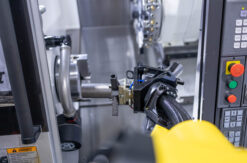
American shops added 244,000 manufacturing jobs in 2024 through reshoring and foreign direct investment, according to the Reshoring Initiative. That total caps a 14-year run that has reshaped industrial capacity from coast to coast. As production returns home, shop floors face a tougher reality: meeting domestic demand requires more output from leaner crews. As a result, the twin ballscrew milling machine has become the format of choice for shops competing on tight tolerances at high feed rates.
Furthermore, the Bureau of Labor Statistics reports the median annual wage for machinists reached $56,150 in May 2024, with about 34,000 projected job openings each year over the next decade. Meanwhile, manufacturers cannot simply hire their way through the order books piling up at U.S. facilities. Instead, they must produce more parts per spindle hour with tighter tolerances, often without adding shifts. Consequently, capital equipment decisions made in 2025 and 2026 will define which shops capture program work and which lose it to faster competitors.
Why the Speed-Precision Equation Has Changed for the Twin Ballscrew Milling Machine
Five years ago, “high speed” and “precision” sat at opposite ends of the spec sheet. Shops chose one or the other. Today, however, machines have closed that gap. Direct-drive spindles spinning at 25,000 RPM and beyond, HSK tool holders designed for high-speed retention, and rigid base construction now appear on machines that hold tolerances measured in microns.
Consequently, the parts being produced have changed too. For example, aerospace structural components, medical implants, automotive prototypes, and EV battery tooling all demand surface finishes and geometric accuracy that once required multiple operations on different machines. By contrast, a modern twin ballscrew milling machine can rough and finish in one setup, eliminating handling errors and saving hours per part. Moreover, single-setup workflows reduce inspection touches, since the part never leaves the work envelope between roughing and finishing passes.
The economics matter beyond cycle time. Each handling step introduces stack-up tolerance risk, additional fixturing costs, and operator labor that does not add value to the finished part. Therefore, consolidating operations onto one capable platform is now a margin lever rather than a convenience.
Reshoring Is Rebuilding Lost Capabilities
The Reshoring Initiative reports that reshoring momentum in 2024 was driven by companies seeking to shorten supply chains, reduce exposure to geopolitical risks, and avoid costs tied to anticipated tariffs. Yet manufacturers are not just moving production back. Instead, they are rebuilding the precision machining, tool and die, and prototype capabilities that left over decades of offshoring.
In addition, government incentives, skilled workforce concerns, and supply chain risks rank as the top three drivers behind reshoring decisions, according to Reshoring Initiative survey data. For example, the Computer and Electronic Products industry led 2024 reshoring announcements, overtaking Electrical Equipment thanks to CHIPS Act momentum. Each of these investments creates downstream demand for tooling, fixturing, and precision components that domestic shops must produce.
For a deeper look at how this reshoring wave intersects with mold and die work, see High RPM Graphite Milling Demand Climbs With EDM Mold Growth. Furthermore, both capital equipment and trained machinists remain in short supply, so the companies winning new contracts pair experienced operators with machines capable of multitasking.
Why a Twin Ballscrew Milling Machine Wins at High Feed Rates
Single-ballscrew designs introduce small but meaningful errors at high feed rates. When the screw extends or contracts, the table follows. On a part with 0.0001-inch tolerances, those errors show up as scrap. By contrast, twin ballscrews drive both ends of the axis simultaneously, balancing forces and reducing thermal drift.
As a result, manufacturers running aerospace work, semiconductor tooling, or medical components increasingly specify twin-ballscrew construction as a baseline. Moreover, the investment pays for itself through reduced scrap, fewer setups, and consistent quality across long production runs. The projections published by the U.S. Bureau of Labor Statistics on machinist openings reinforce why automation-friendly platforms matter for shops that cannot count on hiring their way to higher output.
Additionally, twin-ballscrew architectures handle the dynamic loads created by high-acceleration toolpaths without losing positional accuracy. Modern CAM strategies push feed rates up sharply on roughing and high-efficiency machining cycles. Therefore, machines that drift under load simply cannot run those programs at full speed without quality consequences.
The Workforce Multiplier Effect of a Twin Ballscrew Milling Machine
Today’s machinists program, set up, and run multiple machines per shift. However, that model only works when machines hold accuracy without constant operator intervention. For example, a 25,000 RPM spindle paired with rigid construction lets one machinist supervise two or three cells while the equipment does the heavy lifting. Therefore, this shift toward what observers call the “force multiplier” model is essential to reshoring’s long-term success, especially as covered in Aerospace Alloy Milling Machine Demand Soars on Record Backlog.
In addition, large-capacity automatic tool changers extend unattended run times. A 60-position ATC handles complex part families that previously demanded mid-program tool swaps and operator intervention. As a result, shops can schedule lights-out runs on jobs that used to require continuous supervision, expanding effective capacity without expanding headcount.
Investment Outlook for 2026 and Beyond
The Reshoring Initiative’s 2025 outlook depends on stable industrial policy, but the underlying drivers remain in place. Tariff uncertainty has accelerated some decisions and delayed others. Even so, capital equipment orders for high-precision domestic capacity continue. As a result, shops that invest now position themselves to capture work that will arrive over the next three to five years as reshoring announcements convert to actual production.
Lead times on high-end machining centers also factor into the math. Many platforms carry six to twelve month delivery windows, and installation, training, and process validation can extend that timeline further. Consequently, shops that wait until program awards land may discover their next available capacity is two years out, by which point the contract has already gone to a competitor that ordered earlier.
For manufacturers evaluating their next equipment purchase, the calculation has shifted. The question is no longer whether to invest in higher-performance machines. Instead, the question is whether current equipment can compete for the work coming home.
Iron Machine Tool: Your Partner in Precision CNC Solutions
At Iron Machine Tool, we deliver high-performance CNC machining solutions to manufacturers facing the demands of reshored production. Founded in 2022 by Steve Brown and headquartered in Minneapolis, our team brings decades of experience to every installation.
Our Services Include:
- 3-Axis Precision Milling — Including the Roku Zeus-86 twin ballscrew milling machine with 25,000 RPM spindle and 60-position ATC
- 5-Axis Machining Technology — Advanced solutions for complex geometries
Ready to Strengthen Your Production? Contact Iron Machine Tool to discuss how a twin ballscrew milling machine can support your operations.
Works Cited
“Machinists and Tool and Die Makers.” Occupational Outlook Handbook, U.S. Bureau of Labor Statistics, www.bls.gov/ooh/production/machinists-and-tool-and-die-makers.htm. Accessed 29 Apr. 2026.
Moser, Harry. “U.S. Manufacturing Reshoring and FDI Top 244,000 Jobs; 2025 Outlook: Potentially Strong but Dependent on Stable Industrial Policy.” Reshoring Initiative, 9 June 2025, reshorenow.org/blog/u-s-manufacturing-reshoring-and-fdi-top-244-000-jobs-in-2024/. Accessed 29 Apr. 2026.