

Iron Machine Tool — Advanced EDM and precision machining technology for Midwest manufacturers, backed by Mitsubishi Machinery Systems.
US metalworking machinery demand is running far ahead of what forecasters expected entering 2026. New orders reached $2.77 billion through the first five months of the year, a 31.9% jump over the same period in 2025, according to AMT – The Association For Manufacturing Technology’s U.S. Manufacturing Technology Orders (USMTO) report. That surprised nearly everyone: forecasts issued at the start of the year had anticipated flat-to-slightly-declining activity. Instead, the momentum built through 2025 — a full-year total of $5.74 billion, up 22.5% over 2024, capped by a record single month of $814.3 million in December — carried straight into the new year. The first quarter alone reached $1.61 billion, a 27.8% year-over-year increase, and the most recent month kept pace: May orders totaled $583.4 million, up 47.8% from a year earlier.
Order Values Are Climbing Faster Than Machine Counts
The single most important signal for the rest of 2026 is buried inside the numbers. AMT reports that the dollar value of orders is rising much faster than the number of machines actually ordered — a divergence that first became visible in 2025 and has widened since. The association attributes the gap to three forces: surging demand for automation, shifting customer industries, and ongoing market distortions from federal policy and geopolitical disruption. In plain terms, shops aren’t just buying more machines; they’re buying more capable, more automated ones, and paying more per unit to get them.
Contract machine shops — the “job shops” that make up the largest purchasing segment — illustrate the trend clearly. Early in 2026 they raised the value of their orders by more than 25%, while the number of units they ordered rose only in the single digits. For the EDM segment specifically, that means integrated electrode and guide changers, robotic part handling, and lights-out capability are shifting from premium options to baseline expectations — a change examined in The Machinist Shortage Is Forcing Shops Toward EDM Automation Through 2026.
Capacity Is Tight, and Manufacturers Are Investing to Fix It
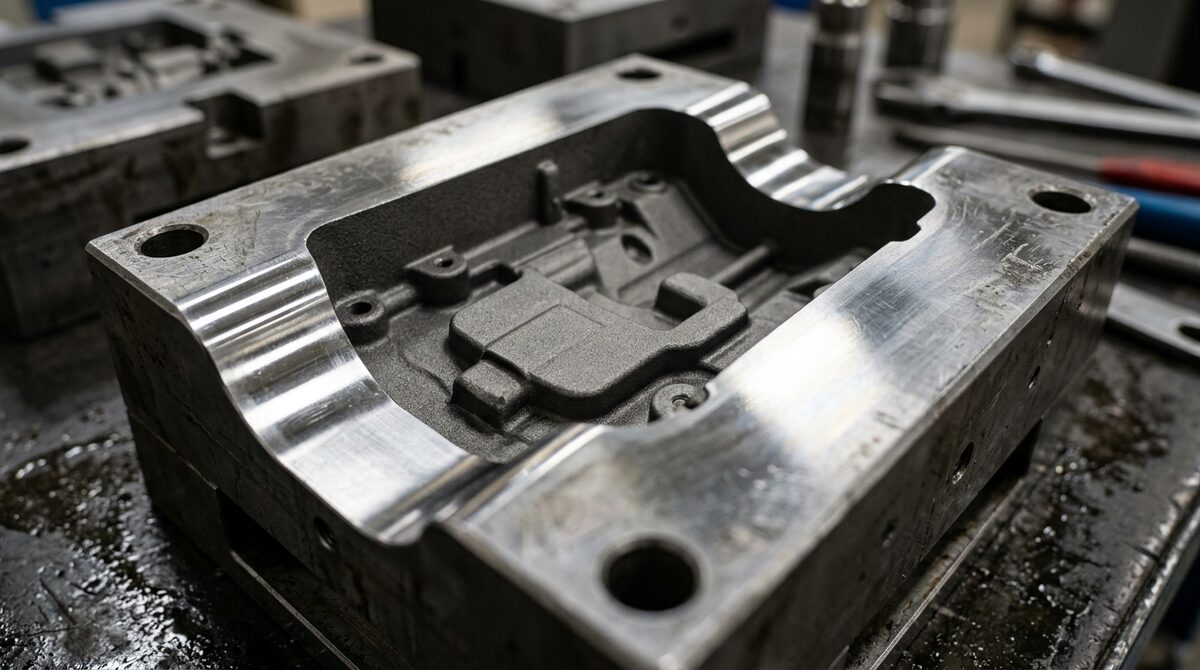
Part of what’s driving equipment demand is how hard existing plants are already running. Federal Reserve data show manufacturing capacity utilization holding in the mid-70% range through 2026 — a level that sits below its long-run 1972–2025 average — even as overall industrial production edges modestly above year-earlier levels. That combination is telling. When output stays elevated but capacity is constrained and utilization can’t climb much higher, manufacturers respond by investing in equipment that squeezes more throughput from the same floor space and the same headcount.
Precision EDM fits that formula almost perfectly. Electrical discharge machining removes material with controlled electrical sparks rather than a cutting edge, so it machines hardened tool steels, carbide, and nickel superalloys without the tool wear that plagues conventional cutting. It holds micron-level tolerances, produces burr-free features, and — critically — runs across shifts with minimal supervision once a job is set. For a plant trying to lift output without adding people or square footage, that profile is exactly what the moment calls for.
Where the Demand Is Coming From
The order surge is not evenly spread across the economy; a few end markets are doing much of the pulling. Aerospace and defense backlogs have climbed to historic highs, driving demand for the small, precise holes and hardened components that EDM is uniquely suited to produce — a dynamic explored in Aerospace and Defense Backlogs Are Rewriting Demand for EDM Hole Drilling in Late 2026. Data centers and electrical infrastructure are adding a second layer of industrial demand as power-hungry computing spreads and utilities expand generation. And across nearly every sector, a deepening skilled-labor shortage is pushing shops toward automated processes that reduce reliance on hard-to-find machinists. Taken together, these forces explain why capital is flowing toward EDM and automated machining rather than conventional capacity that would simply need more operators to run.
What to Watch Through Year-End
AMT’s own read is that the market has real potential for an upside surprise in the back half of 2026. Backlogs are growing, and quotations are steadily converting into firm orders — a pipeline that typically shows up in future shipment totals. The clearest catalyst on the calendar is IMTS, the International Manufacturing Technology Show, which runs September 14–19, 2026, at McCormick Place in Chicago. It is the largest show of its kind in the Western Hemisphere — the 2024 edition drew 89,020 registrants and 1,609 exhibiting companies from more than 110 countries. The show has historically accelerated orders in the second half of its year as manufacturers finalize major equipment decisions on the floor and commit to purchases they had been weighing for months.
Layer that show effect on top of already-rising backlogs and elevated output, and the setup points toward strength — not the slowdown many analysts penciled in last winter. There are real risks in the picture, including tariff shifts and geopolitical uncertainty that AMT itself flags. But the direction of travel is unusually clear for a mid-year read. For manufacturers deciding where to put capital before year-end, the through-line running under all of this data is simple: the shops pulling ahead are investing in precision and automation together, not treating them as a trade-off. A high-tolerance machine that still needs constant manual attention solves only half of today’s problem. A machine that delivers that precision unattended solves both.
Iron Machine Tool: Precision and Automation, Together
Iron Machine Tool helps Midwest manufacturers meet rising demand with advanced EDM and precision machining technology, backed by one of the largest and most experienced service and support networks in the industry through Mitsubishi Machinery Systems.
Our Services Include:
- Machinery Solutions — Wire EDM, Sinker EDM, EDM hole drilling, and 3- and 5-axis precision milling systems
- EDM Automation — Electrode changers, guide changers, and robotic integration for lights-out production
Ready to plan your 2026 capacity investments? Contact Iron Machine Tool to match the right EDM and automation technology to your production goals.
Works Cited
- “$583.4M in New Machinery Orders Highlight US Economic Strengths.” AMT – The Association For Manufacturing Technology, 13 July 2026, www.amtonline.org/article/583-4m-in-new-machinery-orders-highlight-us-economic-strengths. Accessed 22 July 2026.
- “Industrial Production and Capacity Utilization – G.17.” Board of Governors of the Federal Reserve System, 15 May 2026, www.federalreserve.gov/releases/g17/current/default.htm. Accessed 22 July 2026.


