

Iron Machine Tool — Advanced EDM and precision machining technology for Midwest manufacturers, backed by Mitsubishi Machinery Systems.
US manufacturing has a demand problem it can’t hire its way out of. The Manufacturing Institute and Deloitte project the sector will need as many as 3.8 million new workers between 2024 and 2033, and that 1.9 million of those jobs — more than five in ten of the skilled openings — could go unfilled if the skills gap isn’t closed. Sixty-five percent of manufacturers already rank attracting and retaining talent as their single biggest business challenge, a concern that has topped their list in nearly every quarter since 2017.
The Numbers Behind the Squeeze
The pressure is visible in current data, not just long-range projections. The Bureau of Labor Statistics counts roughly 12.6 million manufacturing workers and around half a million open manufacturing jobs each month through 2026 — openings that have stayed stubbornly high even as hiring and separations run near parity, which is why employment looks flat while recruiting stays intense. Machinists, the skilled operators at the heart of precision work, number only about 241,000 nationwide, with a median wage near $58,500 — and experienced EDM and CNC talent is even harder to find and far slower to train than the headcount figures suggest. The manufacturing unemployment rate has hovered in the low-to-mid 3% range, well below what most sectors consider full employment. When a retiring machinist walks out with decades of process knowledge, a shop can’t simply post a requisition and replace them; the person who could fill that role often doesn’t exist in the local labor pool.
Automation Is the Pressure-Release Valve
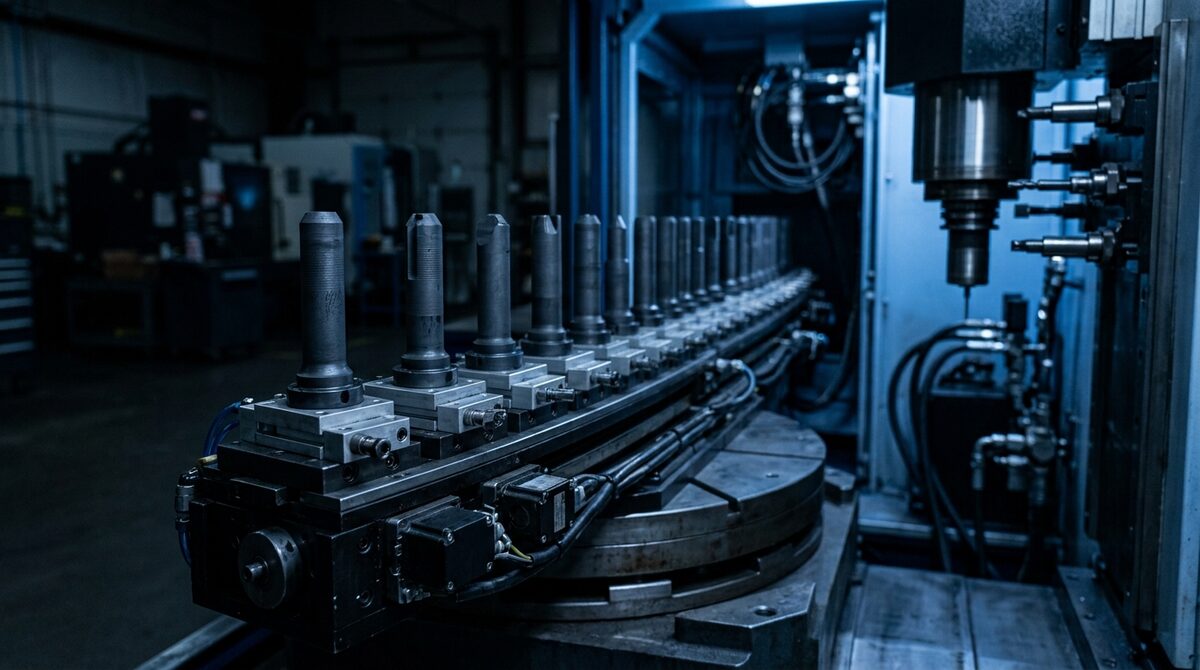
This is the force quietly reshaping equipment buying across the country. AMT has tied the recent surge in machine tool order values — which are rising much faster than the number of units ordered — directly to demand for automation, with US orders running roughly a third ahead of 2025, as covered in The 2026 EDM and Precision Machining Forecast: Automation Powers the Second Half. In the EDM world, automation takes concrete, familiar forms: automatic electrode changers that swap tooling without an operator, automatic guide changers, robotic part loading, rotary and tilt-turn tables, and unattended, lights-out operation that runs a queue of jobs overnight. The economics are straightforward. A single operator can oversee several automated EDM cells at once instead of standing at one machine, and a cell that keeps cutting through an unstaffed third shift converts the labor shortage from a hard ceiling on output into a manageable constraint. The machine, in effect, supplies the labor that the market can’t.
Why EDM Is Especially Suited to This Shift
EDM lends itself to automation better than many machining processes, for reasons rooted in the physics. Because there’s no cutting force pressing on the workpiece and no tool wear in the conventional sense, cycle behavior is highly predictable and repeatable. Quality stays consistent shift after shift without an operator making constant adjustments for a dulling tool or a drifting cut. Add multi-position electrode and guide changers, and a machine can work through a whole queue of jobs on its own, changing its own tooling between them. That predictability does something valuable beyond saving labor: it removes one of the most common sources of scrap, which matters enormously for the high-value aerospace and defense parts that can’t tolerate variability — the work described in Aerospace and Defense Backlogs Are Rewriting Demand for EDM Hole Drilling in Late 2026. Consistency isn’t just a quality metric here; it’s what makes unattended running safe to trust.
The Cost of Standing Still
The shops most exposed are the ones betting they can simply out-recruit the shortage. With openings running near half a million a month and skilled operators in especially short supply, that is a bet against demographics. Turning down work because there’s no one to run a machine is an invisible but very real cost — lost revenue that never shows up on a scrap report. Automation changes that equation by decoupling output from headcount: capacity becomes a function of machine hours a shop already owns rather than people it can’t find. For a precision shop, the question through the rest of 2026 isn’t really whether automation pays for itself. It’s whether the shop can afford to keep leaving the third shift dark while competitors run theirs unattended.
What the Workforce Data Says About the Rest of 2026
Nothing about the labor math improves in the near term. The skills gap is structural, not cyclical, and the wave of retirements is demographic — baby boomers leaving faster than younger workers can be trained to replace them. Manufacturers know it: more than nine in ten surveyed by the Manufacturing Institute are forming at least one workforce partnership, and on average they are partnering with four or more schools, colleges, and agencies to build talent pipelines. The most common partners are technical colleges (73%), industry associations (58%), and universities (48%), and nearly half of manufacturers point to apprenticeships and internships as the most effective way to draw people into the field. Nearly half also say flexible scheduling is the single most impactful lever for keeping the workers they already have. Those efforts matter, but they take years to pay off. In the meantime, automation is less a competitive edge than a survival strategy for precision shops through year-end and into 2027. The manufacturers pulling ahead are treating automated EDM not as a luxury purchase but as their single most reliable source of additional capacity.
Iron Machine Tool: Automation That Fills the Gap
Iron Machine Tool helps Midwest shops do more with the people they have, supplying automated EDM and milling systems backed by Mitsubishi Machinery Systems’ service network.
Our Services Include:
- EDM Automation — Electrode changers, guide changers, and robotic integration for lights-out EDM
- Milling Automation — Automated cells that extend capacity without added headcount
Ready to turn the labor shortage into an automation advantage? Contact Iron Machine Tool to build a plan that fits your shop.
Works Cited
- “Manufacturers Need as Many as 3.8 Million New Employees by 2033.” The Manufacturing Institute, themanufacturinginstitute.org/manufacturers-need-as-many-as-3-8-million-new-employees-by-2033/. Accessed 22 July 2026.
- “Manufacturing: NAICS 31-33.” U.S. Bureau of Labor Statistics, 4 June 2026, www.bls.gov/iag/tgs/iag31-33.htm. Accessed 22 July 2026.


