
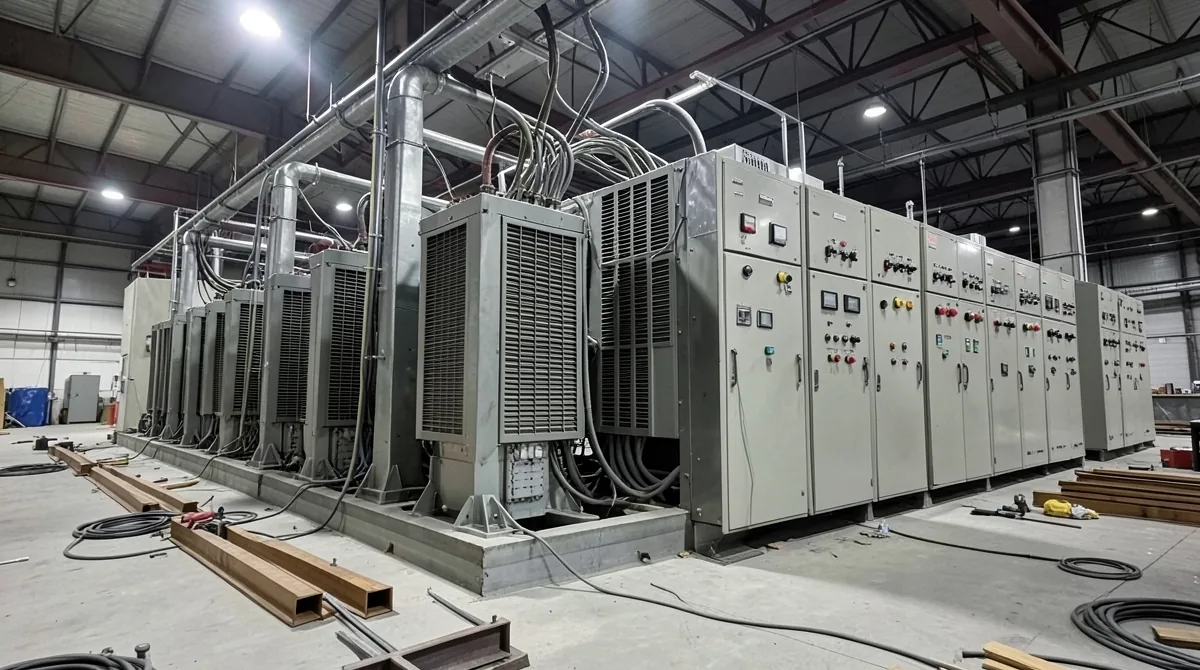
American electricity demand spent roughly fifteen years going nowhere. That period is over, and the equipment needed to carry the new load has to be built before it can be installed.
The demand signal is now on the record
On September 9, 2026, the U.S. Energy Information Administration reported that it expects U.S. electricity generation to grow 2.2 percent to a record 4,368 billion kilowatthours this year, with another 1.7 percent growth in 2027.
The demand side carries the same shape. EIA expects electricity sales to total 4,135 billion kilowatthours in 2026, up almost 2 percent from 2025, and to rise another 2 percent to 4,211 billion kilowatthours in 2027. The agency names two drivers behind growth in the commercial and industrial sectors: data center development and increased manufacturing activity.
Read that second driver carefully. Manufacturing growth is showing up as electricity demand, and electricity demand is generating manufacturing growth. The loop runs both directions.
The labor projections say the same thing louder
Federal employment projections make the equipment side explicit.
In a May 2026 analysis, the Bureau of Labor Statistics identified other electrical equipment and component manufacturing as the fastest growing manufacturing industry, projected to expand 29 percent from 2024 to 2034. Employment in the industry is projected to rise from 165,700 to 214,100, an increase of about 48,400 jobs. That is also the largest numeric job gain of any manufacturing industry over the decade.
Semiconductor and other electronic component manufacturing sits close behind, projected to grow 11 percent and add about 44,500 jobs, with a 2024 median annual wage of $73,980.
Set those two industries side by side and the picture is clear. The parts of American manufacturing projected to grow fastest are the ones that generate, store, move, and control electricity.
Where the tooling demand actually lands
Electrical equipment is not one product category. It is a long list of things that each need their own tooling.
Enclosures, control boxes, and housings. Sheet metal forming needs dies. Dies need cutting, and progressive dies need features that conventional tooling struggles to produce.
Laminations and cores. Transformers and motors run on stacked laminations produced by progressive stamping dies. Die accuracy determines stack quality, and stack quality determines efficiency.
Connectors and terminals. Small, high-volume, tight-tolerance parts, stamped from dies that have to hold their geometry across production runs measured in millions.
Battery components. Storage sits behind much of the load growth, and battery manufacturing carries its own tooling requirements for housings, tabs, and forming tools.
Busbar and power distribution hardware. Larger parts, but with tolerance and finish requirements that follow from the electrical function.
Nearly every item on that list resolves to the same upstream question: who cuts the die, and how tight can they hold it? The same question is being asked in aerospace, where a 20-year fleet forecast has run ahead of the supply base that has to build to it.
Why EDM shows up in stamping die work
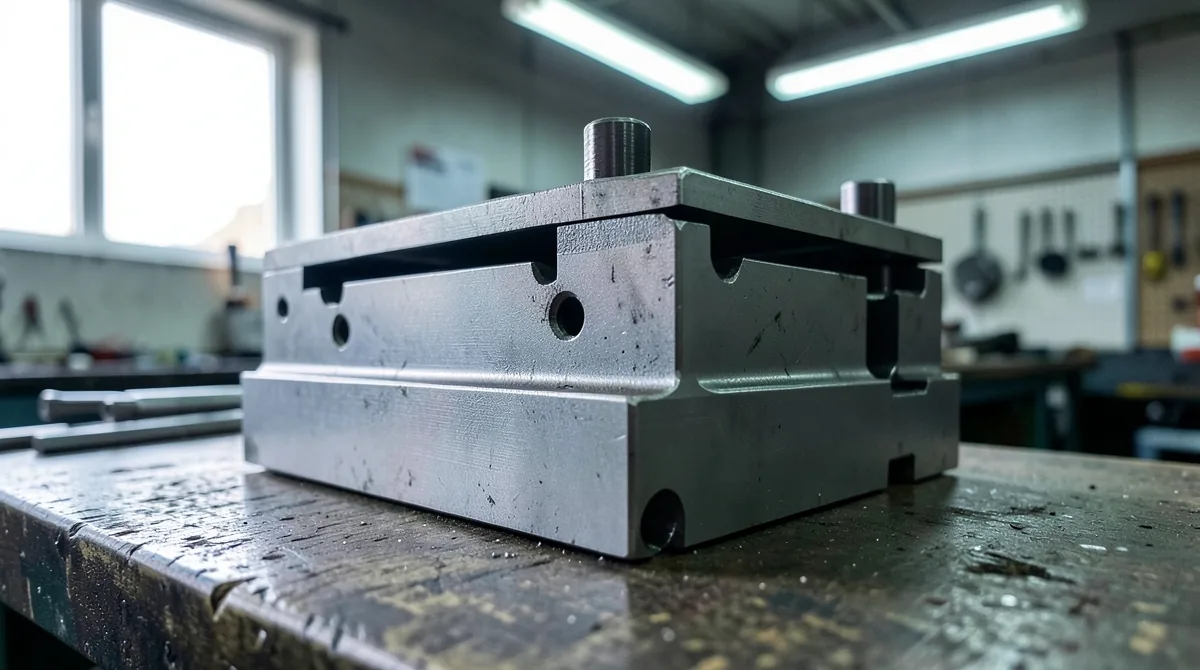
Progressive die construction is one of the clearest applications for electrical discharge machining, for a specific reason. Dies are hardened before final machining, because hardening after machining moves the geometry.
Conventional cutting tools struggle on hardened tool steel. EDM does not care about hardness, because it removes material through controlled electrical discharge rather than cutting force.
Wire EDM cuts punch profiles and die openings in hardened stock with a small-diameter wire, holding corner radii that no end mill can reach.
Sinker EDM produces blind cavities, forming details, and sharp internal corners in the same hardened material.
Hole drilling burns pilot holes, vents, and starter holes for wire EDM through hardened plate.
Die shops running electrical equipment work commonly use all three on the same die.
Volume is what changes the machine decision
High-volume electrical component work differs from mold work in one operationally important way: the parts repeat.
A mold shop might burn a cavity once. Die shops supporting connector production burn the same features across die sections, spare punches, and replacement details, over and over. Repetition is exactly the condition automation was designed for.
Automatic electrode changers work through staged sequences without an operator standing by. Robot cells move electrodes and workpieces between pallets, feeding hours of burn time from a single setup. Multi-machine cells spread the automation investment across more machines and more hours.
The result is that the same headcount covers more spindle hours, which is the practical constraint for most shops chasing volume growth.
What electrical equipment manufacturing growth asks of a supplier
Growth at this pace changes what customers need from a tooling supplier. Four requirements come up repeatedly.
Die life over die price. A connector die running millions of cycles is judged on how long it holds tolerance, not on what it cost to build.
Fast replacement details. When a punch fails mid-run, the line stops. Suppliers who can cut a replacement detail quickly become the ones who get called.
Repeatable geometry across die sections. Multi-station progressive dies need each station to match the print, every time the tool is rebuilt.
Documentation that travels. Electrical equipment feeds regulated end markets, and inspection records follow the part downstream.
Suppliers who solve those four things together, rather than one at a time, are the ones electrical equipment manufacturing growth rewards. That is a capacity and process question more than a pricing question.
The Midwest read
Minnesota, Wisconsin, and Iowa hold a substantial base of electrical, industrial, and control equipment manufacturing alongside the tool and die shops that supply it. Regional shops looking at this demand have a decision with a timing element.
Electrical equipment growth is projected across a decade, not a quarter. That is unusually long visibility for a capital equipment decision, and it favors shops willing to build capacity before the order lands rather than after.
The same logic is running through other sectors right now. Medical device suppliers are working through a federal quality regulation that changed in February, and shops serving more than one of these sectors are making a single capacity decision that answers several demand signals at once.
Iron Machine Tool: EDM and Precision Milling for Midwest Manufacturers
Iron Machine Tool is the exclusive Midwest distributor for Mitsubishi Electric, OPS-Ingersoll, and Roku-Roku Sangyo, serving manufacturers across Minnesota, Wisconsin, Iowa, and surrounding states from Minneapolis. Steve Brown founded the company in 2022 and brings 15+ years of hands-on EDM experience, handling inquiries directly. Iron Machine Tool supports customers from consultation through installation, training, and ongoing service. Mitsubishi machines are supported by MC Machinery Systems, which operates 5 Technical Centers across North America with over 300 dedicated service professionals.
Our Machinery Solutions Include:
- Industries We Serve — industrial and electrical, robotics, automotive, aerospace, medical, and commercial manufacturing applications
- EDM Automation — EROWA robotics and multi-machine cells built for unattended overnight running
Evaluating a machine? Talk to Steve Brown about your application, tolerances, and timeline.
Works Cited
- “EIA Expects Record Electricity Generation in 2026 and 2027.” U.S. Energy Information Administration, U.S. Department of Energy, 9 Sept. 2026, www.eia.gov/pressroom/releases/press592.php. Accessed 20 Sept. 2026.
- Farrell, Ryan, and Lindsey Ice. “Producing the Goods of the Future: Job Opportunities in Manufacturing.” Career Outlook, U.S. Bureau of Labor Statistics, May 2026, www.bls.gov/careeroutlook/2026/article/manufacturing.htm. Accessed 20 Sept. 2026.


