

The hardest number in metalworking right now is not a tolerance. It is 49,300. That is where the Bureau of Labor Statistics projects tool and die maker employment will land in 2034, down from 55,200 in 2024.
The occupation losing people fastest is the one mold shops need most
BLS groups machinists and tool and die makers together in its projections, and the combined figure looks mild. The group held 354,800 jobs in 2024, falling about 2 percent to 348,800 by 2034. Split the group apart and the picture changes.
Machinist employment is projected flat, holding near 299,500. Tool and die makers are projected to decline 11 percent, a loss of roughly 6,000 positions. That is the steepest drop in the group, and it lands squarely on the people who build molds and dies.
The replacement math is the part shops feel every week. BLS projects about 34,200 openings a year across machinists and tool and die makers over the decade. All of those openings come from replacement, as workers move into other occupations or retire. None of them come from growth.
Why EDM feels this harder than milling
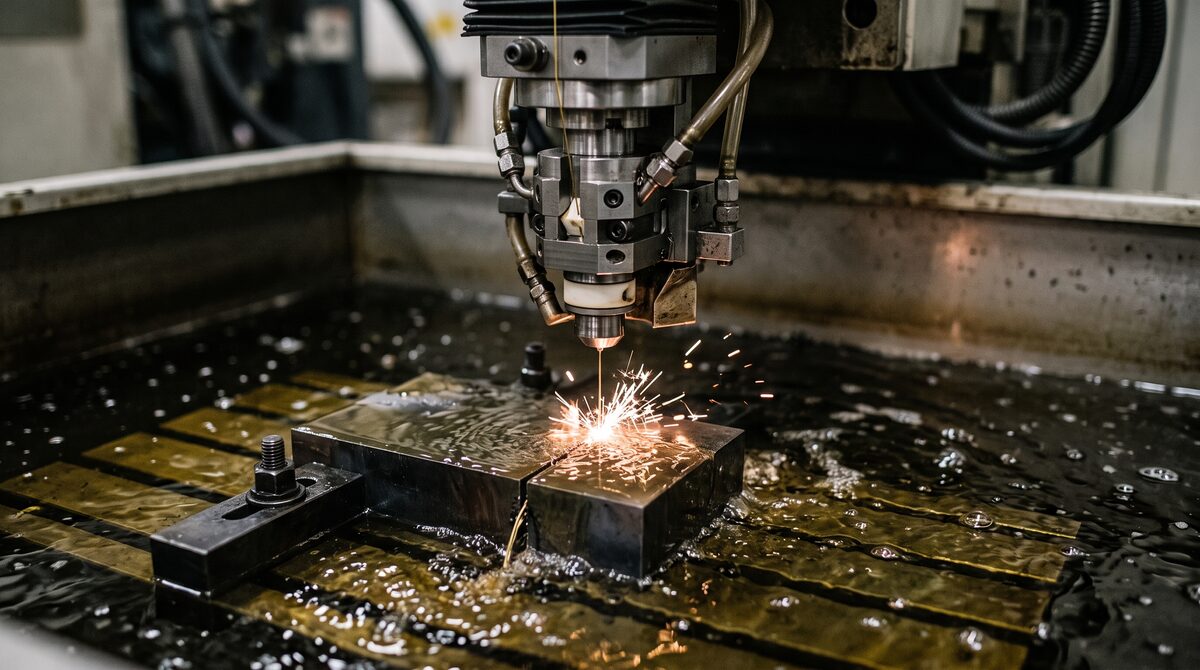
Sinker EDM is not a button-press process. Someone decides the electrode material and the electrode count. That person also sets the undersize for each burn stage, the orbit pattern, and the flush strategy. Judgment calls follow about where to accept a corner radius the wire could not have held anyway. That knowledge tends to live in the same heads that BLS is counting down.
A CNC mill can be handed to a competent operator with a proven program. Sinker work is different. Burning a new cavity calls for judgment about a process that removes material by spark erosion rather than by cutting. Losing a tool and die maker with fifteen years of burn experience is not a headcount problem. It is a capability problem.
Pay reflects the scarcity. BLS put median annual wages for tool and die makers at $63,180 in May 2024, against $56,150 for machinists and $49,500 across all occupations. Shops raising wages to hold people are competing for a pool that is contracting.
The response has been unattended running, not more hiring
Small and medium-sized manufacturers make up 98 percent of the U.S. manufacturing base, and most tool rooms sit in that group. Federal policy has moved toward helping them adopt automation rather than expecting the labor pool to refill.
In July 2026, NIST released a funding opportunity for 14 new Manufacturing Extension Partnership centers. The stated focus is helping small and medium-sized manufacturers adopt advanced technologies, including robotics and automation. Those centers join a network of nearly 1,400 manufacturing advisers at more than 450 service locations.
The practical shop-floor version of that policy looks like this:
Electrode changers. A sinker EDM with an automatic tool changer can work through a staged electrode sequence without an operator standing by for each swap.
Robot cells. EROWA robots and similar systems move electrodes and workpieces between pallets, letting one setup feed hours of burn time.
Multi-machine cells. A single robot serving several machines spreads the automation cost across more spindle hours and more burn hours.
Graphite milling integration. A 5-axis graphite mill feeding a sinker keeps electrode supply ahead of the burn queue rather than behind it.
What unattended running actually buys
The clearest gain is calendar time. A burn that runs overnight returns hours that were sitting idle. The shift arriving in the morning starts from a finished stage rather than a setup.
A second gain is quieter. Automation moves the skilled person off machine tending and onto the work that needs judgment: electrode strategy, first article inspection, process planning, and training the next operator. A shop with two experienced tool and die makers can cover more machines when neither one spends the shift changing electrodes by hand.
That is a different argument than the one automation vendors made a decade ago. This is not about replacing people who are hard to find. It is about giving the people already on staff more reach.
Knowledge transfer is the other half of the problem
Automation covers machine hours. It does not cover judgment, and judgment is what walks out the door at retirement.
Shops that have handled this well tend to do a few unglamorous things.
Write down the burn parameters. Undersize values, orbit patterns, and flush setups for recurring part families belong in a document rather than in one person’s memory.
Pair people deliberately. An experienced tool and die maker working beside a newer machinist transfers more in six months than any classroom sequence.
Use apprenticeships. BLS notes that machinists and tool and die makers typically train on the job. Many come up through employer-sponsored apprenticeships that pair paid work with technical instruction at a community or technical college.
Hire for aptitude over resume. With tool and die maker employment contracting, the pool of people who already hold the skill is thin. Plenty of people could learn it.
What this changes about buying a machine
The shortage has quietly moved the evaluation criteria for a sinker EDM purchase.
Ten years ago, the questions were mostly about the machine: tolerance, tank size, generator, control. Those still matter. What has been added is a second set of questions about the hours around the machine.
Can it run a staged electrode sequence without an operator? What does adding a robot cost later, and does the machine support it? Who trains the operator, and how long does that take? And who answers the phone at 2 a.m. when a cell stops mid-burn?
How this connects to the rest of the decision
Adding automation is a capital purchase, and it arrives during a cycle where two other variables are moving. Federal duty treatment for imported machine tools is still undecided as of August 2026 [PLACEHOLDER: Machine Tool Tariffs in 2026: What the Section 232 Machinery Investigation Means for EDM Buyers], and tooling backlogs have been building for nearly two straight years [PLACEHOLDER: Die and Mold Industry Trends: Record Capital Spending Meets a Capacity Squeeze].
Shops evaluating automation this cycle tend to start from the same question: which hours are currently going unused, and what would it take to run them? That question has a clearer answer than any forecast about hiring.
Iron Machine Tool: EDM and Precision Milling for Midwest Manufacturers
Iron Machine Tool is the exclusive Midwest distributor for Mitsubishi Electric, OPS-Ingersoll, and Roku-Roku Sangyo, serving manufacturers across Minnesota, Wisconsin, Iowa, and surrounding states from Minneapolis. Steve Brown, who founded the company in 2022, brings 15+ years of hands-on EDM experience and handles inquiries directly. Mitsubishi machines are supported by MC Machinery Systems, which operates 5 Technical Centers across North America with over 300 dedicated service professionals. Iron Machine Tool supports customers from consultation through installation, training, and ongoing service.
Our Machinery Solutions Include:
- Sinker EDM — Mitsubishi and OPS-Ingersoll sinker EDM for cavity, rib, and detail work in hardened tool steel
- EDM Automation — EROWA robots, OPS-Ingersoll 5-axis graphite milling cells, and multi-machine wire EDM automation built for unattended overnight running
Evaluating a machine? Talk to Steve Brown about your application, tolerances, and timeline.
Works Cited
- “Machinists and Tool and Die Makers.” Occupational Outlook Handbook, U.S. Bureau of Labor Statistics, 28 Aug. 2025, www.bls.gov/ooh/production/machinists-and-tool-and-die-makers.htm. Accessed 17 Aug. 2026.
- “NIST Announces Funding Opportunity for 14 MEP Centers to Advance Small and Medium-Sized U.S. Manufacturers.” National Institute of Standards and Technology, U.S. Department of Commerce, 22 July 2026, www.nist.gov/news-events/news/2026/07/nist-announces-funding-opportunity-14-mep-centers-advance-small-and-medium. Accessed 17 Aug. 2026.


