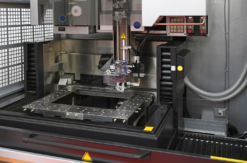
Ohio’s manufacturing landscape demands cutting-edge precision machining solutions that can handle the most complex geometries and tight tolerances. From automotive components in Cleveland to aerospace parts in Dayton, manufacturers across the Buckeye State require reliable, accurate machining processes that conventional methods simply cannot deliver.
Iron Machine Tool’s sinker EDM solutions provide Ohio manufacturers with the precision, reliability, and efficiency needed to compete in today’s demanding marketplace. Our advanced electrical discharge machining technology opens new possibilities for producing intricate components that would be impossible or cost-prohibitive with traditional machining methods.
Understanding Sinker EDM Technology for Ohio Manufacturing
Sinker EDM, also known as ram EDM or plunge EDM, represents a revolutionary approach to precision machining that uses controlled electrical discharges to remove material from workpieces. This process creates components with exceptional surface finishes and dimensional accuracy that Ohio’s precision manufacturing sector demands.
The technology works by creating a series of rapid electrical discharges between a specially designed electrode and the workpiece, both submerged in a dielectric fluid. Each discharge removes a tiny amount of material, gradually shaping the workpiece to match the electrode’s form with remarkable precision.
Ohio manufacturers benefit from sinker EDM’s ability to machine hardened materials up to 60+ HRC without affecting the material’s metallurgical properties. This capability proves invaluable for producing tooling, dies, and complex components that must maintain their structural integrity throughout demanding production cycles.
Key Advantages of Sinker EDM for Ohio’s Manufacturing Sector
Superior Precision and Surface Quality
Sinker EDM technology delivers surface finishes as fine as 0.1 μm Ra, making it ideal for Ohio’s medical device manufacturers, precision tooling companies, and aerospace suppliers. The process achieves tolerances within ±0.0001 inches, meeting the exacting standards required by industries throughout the region.
The technology’s ability to maintain consistent precision across complex geometries makes it particularly valuable for Ohio’s diverse manufacturing base. Whether producing intricate mold cavities in Toledo or precision aerospace components in Cincinnati, sinker EDM ensures repeatable accuracy that traditional machining methods cannot match.
Machining Hardened Materials Without Heat Distortion
Ohio’s tool and die manufacturers face constant pressure to work with increasingly hard materials while maintaining dimensional stability. Sinker EDM excels at machining materials like D2, A2, H13, and carbide without generating heat that could cause distortion or affect material properties.
This cold machining process eliminates the need for pre-heat treatment softening, reducing production time and maintaining the material’s intended hardness throughout the component. Ohio manufacturers report significant time savings and improved part quality when switching from conventional machining to sinker EDM for hardened materials.
Complex Geometry Capabilities
The ability to create intricate internal cavities, sharp corners, and complex three-dimensional shapes makes sinker EDM indispensable for Ohio’s injection molding and die casting industries. Components that would require multiple setups and specialized tooling with conventional methods can be completed in a single sinker EDM operation.
Ohio manufacturers leverage this capability to produce everything from complex cooling channels in plastic injection molds to intricate electrode designs for automotive applications. The technology’s flexibility enables rapid prototyping and production of low to medium volume parts with complex geometries.
Strategic Applications Across Ohio’s Manufacturing Industries
Automotive Manufacturing Excellence
Ohio’s automotive sector, centered around major production facilities in Toledo, Lima, and Lordstown, relies heavily on precision tooling and dies for stamping, forming, and molding operations. Sinker EDM technology produces the complex cavity shapes required for automotive body panels, engine components, and transmission housings.
Local automotive suppliers report that sinker EDM technology reduces lead times for new tooling by 30-40% compared to conventional machining methods. The ability to machine hardened tool steels directly eliminates secondary heat treatment operations and reduces the risk of distortion during processing.
Ohio’s electric vehicle component manufacturers particularly benefit from sinker EDM’s precision capabilities when producing battery housings, motor components, and charging system parts that require exact specifications and exceptional surface quality.
Aerospace Component Production
The Dayton region’s aerospace manufacturing cluster depends on sinker EDM technology for producing critical components that meet stringent quality and performance requirements. From turbine blade cooling passages to landing gear components, the technology enables Ohio manufacturers to compete for high-value aerospace contracts.
Sinker EDM’s ability to machine exotic alloys like Inconel, titanium, and other aerospace-grade materials makes it essential for Ohio companies serving this sector. The process maintains tight tolerances and surface finish requirements that are critical for aerospace applications.
Medical Device Manufacturing
Ohio’s growing medical device sector, particularly in Cleveland and Columbus, requires components with exceptional precision and surface quality. Sinker EDM technology produces surgical instruments, implant components, and medical device housings that meet FDA requirements and industry standards.
The technology’s ability to create complex internal channels and cavities proves valuable for producing medical components like catheter manufacturing dies, surgical tool blanks, and precision injection molding tooling for medical devices.
Economic Benefits for Ohio Manufacturers
Reduced Production Costs
Sinker EDM technology eliminates many secondary operations required with conventional machining, reducing overall production costs for Ohio manufacturers. The ability to machine components to near-net shape reduces material waste and finishing requirements.
Local manufacturers report cost savings of 20-35% on complex components when switching to sinker EDM technology. These savings result from reduced setup times, elimination of multiple operations, and decreased material waste compared to traditional machining approaches.
Improved Production Efficiency
Modern sinker EDM systems feature automated electrode changing, programmable cycles, and advanced process monitoring that maximizes uptime and productivity. Ohio manufacturers benefit from unmanned operation capabilities that allow continuous production during off-shifts.
The technology’s repeatability ensures consistent part quality from the first piece to the last, reducing scrap rates and inspection requirements. This consistency proves particularly valuable for Ohio manufacturers serving industries with strict quality requirements.
Enhanced Competitive Positioning
Access to advanced sinker EDM technology enables Ohio manufacturers to compete for contracts that require capabilities beyond conventional machining. This technological edge helps local companies secure higher-value work and expand their market reach.
The ability to offer short lead times on complex components gives Ohio manufacturers a significant advantage when competing against suppliers in other regions. Quick turnaround capabilities prove especially valuable for prototype work and urgent production requirements.
Technical Specifications and Capabilities
Machine Size and Work Envelope Options
Ohio manufacturers can select from various sinker EDM configurations to match their specific production requirements. Compact desktop units handle small precision components, while large industrial systems accommodate substantial workpieces up to several thousand pounds.
Work envelope options range from 8″ x 6″ x 8″ for precision tooling applications to 60″ x 40″ x 24″ for large mold and die work. Ohio manufacturers appreciate the flexibility to choose machines that match their typical workpiece sizes without paying for unused capacity.
Electrode Material Options
Sinker EDM technology accommodates various electrode materials including graphite, copper, and copper-tungsten alloys. Each material offers specific advantages for different applications, allowing Ohio manufacturers to optimize their processes for specific requirements.
Graphite electrodes provide excellent wear characteristics and fine surface finishes, making them ideal for precision applications. Copper electrodes offer superior dimensional stability and are preferred for high-accuracy work, while copper-tungsten provides exceptional wear resistance for high-volume production.
Surface Finish Capabilities
Modern sinker EDM systems produce surface finishes ranging from 32 μin Ra for rough operations to 0.1 μin Ra for mirror-finish applications. Ohio manufacturers use these capabilities to eliminate secondary finishing operations on many components.
The ability to control surface texture through process parameters allows manufacturers to optimize components for specific applications. Textured surfaces for improved adhesion, smooth finishes for reduced friction, and controlled roughness for enhanced functionality all become achievable through proper sinker EDM programming.
Implementation Considerations for Ohio Manufacturers
Facility Requirements and Setup
Sinker EDM systems require stable electrical power, proper filtration systems, and climate-controlled environments for optimal performance. Ohio manufacturers should plan for adequate floor space and proper ventilation when installing sinker EDM equipment.
Power requirements typically range from 10-50 KVA depending on machine size and configuration. Proper electrical infrastructure ensures consistent performance and protects the investment in precision machining equipment.
Operator Training and Skill Development
Successful sinker EDM implementation requires skilled operators who understand both the technology and the specific requirements of Ohio’s manufacturing applications. Training programs typically require 2-4 weeks for operators to become proficient with basic operations.
Advanced programming and electrode design skills require additional training but provide significant competitive advantages. Understanding the capabilities of sinker EDM helps operators maximize equipment potential and achieve superior results. Ohio manufacturers report that investing in comprehensive operator training pays dividends through improved productivity and part quality.
Integration with Existing Operations
Sinker EDM technology integrates well with existing manufacturing operations, often complementing conventional machining centers and other production equipment. Ohio manufacturers frequently use sinker EDM for operations that conventional methods cannot perform effectively.
The technology’s ability to work with hardened materials means it often fits into production sequences after heat treatment, eliminating the need for soft machining followed by finish grinding or other secondary operations.
Maintenance and Long-Term Performance
Preventive Maintenance Requirements
Sinker EDM systems require regular maintenance to ensure consistent performance and long service life. Daily maintenance tasks include checking dielectric fluid levels, cleaning filters, and verifying system calibration.
Weekly maintenance involves more thorough cleaning of the work tank, inspection of electrical connections, and verification of positioning accuracy. Ohio manufacturers report that following manufacturer-recommended maintenance schedules significantly extends machine life and maintains precision capabilities.
Operating Cost Considerations
Operating costs for sinker EDM include electricity, dielectric fluid, electrodes, and filters. Ohio manufacturers typically see operating costs of $15-25 per hour depending on machine size and utilization rates.
These costs must be weighed against the value provided through improved precision, reduced secondary operations, and the ability to machine materials and geometries that conventional methods cannot handle effectively.
Service and Support Infrastructure
Access to qualified service technicians and readily available spare parts is critical for maintaining sinker EDM equipment. Ohio manufacturers benefit from established service networks that provide rapid response for both routine maintenance and emergency repairs.
Local technical support ensures minimal downtime and helps Ohio manufacturers maximize their return on investment in sinker EDM technology. Training programs for maintenance staff further reduce dependence on outside service providers.
Quality Control and Inspection Integration
In-Process Monitoring Capabilities
Modern sinker EDM systems feature advanced monitoring capabilities that track process parameters in real-time. These systems detect variations that could affect part quality and make automatic adjustments to maintain consistent results.
Ohio manufacturers use these capabilities to reduce inspection requirements and ensure consistent part quality throughout production runs. Automated process monitoring proves particularly valuable for unmanned operation during off-shifts.
Dimensional Accuracy and Verification
Sinker EDM technology maintains exceptional dimensional accuracy throughout the machining process. Ohio manufacturers typically verify part dimensions using coordinate measuring machines, optical comparators, or other precision measurement equipment.
The technology’s repeatability means that once process parameters are established and verified, subsequent parts will maintain the same dimensional characteristics. This consistency reduces sampling inspection requirements and improves overall quality assurance efficiency.
Documentation and Traceability
Modern sinker EDM systems provide comprehensive process documentation that supports quality management systems and customer requirements. Ohio manufacturers benefit from automated data collection that tracks critical process parameters for each component.
This documentation capability proves valuable for aerospace, medical, and automotive applications where traceability requirements are stringent. Automated record-keeping reduces administrative burden while ensuring compliance with industry standards.
Future Technology Developments
Automation and Industry 4.0 Integration
Advanced sinker EDM systems increasingly incorporate automation features like robotic loading, automated electrode changing, and integration with manufacturing execution systems. Ohio manufacturers are positioning themselves to benefit from these technological advances.
Smart manufacturing capabilities enable remote monitoring, predictive maintenance, and process optimization that further improve productivity and reduce operating costs. These features help Ohio manufacturers remain competitive in an increasingly automated manufacturing environment.
Process Optimization Software
Sophisticated software packages optimize sinker EDM operations by analyzing part geometry, material properties, and quality requirements to determine optimal process parameters. Ohio manufacturers use these tools to reduce programming time and improve first-part success rates.
Machine learning algorithms incorporated into modern systems continuously improve process parameters based on historical performance data. This capability helps Ohio manufacturers achieve better results over time as their systems learn from experience.
Environmental and Safety Considerations
Environmental Impact Management
Sinker EDM systems use dielectric fluids that require proper handling, storage, and disposal according to environmental regulations. Ohio manufacturers must implement appropriate waste management procedures to ensure compliance with state and federal environmental requirements.
Modern systems incorporate recycling capabilities that extend dielectric fluid life and reduce waste generation. Filtration systems remove contaminants and allow fluid reuse, reducing both environmental impact and operating costs.
Workplace Safety Requirements
Sinker EDM operations require appropriate safety measures including proper ventilation, electrical safety procedures, and personal protective equipment. Ohio manufacturers must ensure operators receive proper safety training and follow established procedures.
Safety systems built into modern sinker EDM equipment protect operators and equipment from electrical hazards, fire risks, and other potential dangers. Regular safety audits and training updates help maintain safe working conditions.
Industry-Specific Applications in Ohio
Tool and Die Manufacturing
Ohio’s tool and die industry represents one of the largest applications for sinker EDM technology in the region. From plastic injection mold cavities to progressive die stations, the technology enables local shops to compete effectively for high-precision work.
Complex cooling channels, intricate cavity details, and tight corner radii that characterize modern tooling designs are ideally suited to sinker EDM capabilities. Ohio tool and die shops report that sinker EDM technology is essential for remaining competitive in today’s marketplace.
Precision Manufacturing Services
Contract manufacturers throughout Ohio use sinker EDM technology to offer specialized services that differentiate them from conventional machine shops. The ability to handle exotic materials and complex geometries opens new market opportunities.
Low to medium volume production runs benefit significantly from sinker EDM’s setup efficiency and programming flexibility. Sinker EDM machines and their applications demonstrate how Ohio contract manufacturers use this capability to serve customers requiring quick turnaround on precision components.
Additional Resources and Industry Standards
For Ohio manufacturers seeking additional information about sinker EDM technology standards and best practices, several authoritative resources provide valuable guidance:
The National Institute of Standards and Technology (NIST) offers comprehensive guidelines for precision manufacturing processes and quality control standards that apply to EDM operations. Their manufacturing technology initiatives help Ohio companies implement best practices and maintain competitive advantages.
The Society of Manufacturing Engineers (SME) provides technical resources, training programs, and industry networking opportunities specific to advanced manufacturing technologies including EDM processes. Ohio manufacturers benefit from SME’s local chapters and continuing education programs focused on precision manufacturing excellence.
Call to Action
Ready to transform your Ohio manufacturing operation with advanced sinker EDM technology? Contact Iron Machine Tool today to discuss how our comprehensive sinker EDM solutions can improve your precision manufacturing capabilities, reduce production costs, and open new market opportunities.
Frequently Asked Questions
What types of materials can sinker EDM machine effectively in Ohio manufacturing applications?
Sinker EDM technology excels at machining any electrically conductive material regardless of hardness. Ohio manufacturers commonly use it for tool steels (D2, A2, H13, S7), carbide, hardened stainless steel, Inconel, titanium, and other exotic alloys. The process maintains consistent precision across materials ranging from soft copper to hardened tool steels at 60+ HRC. This versatility makes it particularly valuable for Ohio’s diverse manufacturing base, where different industries require various specialized materials. Unlike conventional machining, sinker EDM performance is not affected by material hardness, allowing manufacturers to work with pre-hardened materials without risk of distortion or dimensional changes.
How does sinker EDM compare to wire EDM for Ohio manufacturing applications?
Sinker EDM and wire EDM serve different but complementary roles in Ohio manufacturing operations. Sinker EDM excels at creating complex three-dimensional cavities, blind holes, and intricate internal shapes that wire EDM cannot produce. It’s ideal for mold cavities, die impressions, and components requiring complex internal geometries. Wire EDM, in contrast, cuts through-holes and creates two-dimensional profiles with exceptional accuracy. Ohio manufacturers often use both technologies, with wire EDM handling cutting operations and sinker EDM creating complex cavities and internal features. The choice depends on part geometry, with sinker EDM being the only option for closed internal cavities and complex three-dimensional shapes.
What level of precision can Ohio manufacturers expect from sinker EDM technology?
Modern sinker EDM systems deliver exceptional precision that meets the demanding requirements of Ohio’s aerospace, medical, and automotive industries. Typical dimensional tolerances range from ±0.0001″ to ±0.0005″ depending on part size and geometry complexity. Surface finishes can achieve 0.1 μin Ra for mirror-quality applications or be controlled to specific textures for functional requirements. Corner radii as small as 0.001″ are achievable, enabling intricate detail work impossible with conventional machining. Ohio manufacturers report achieving repeatable accuracy within ±0.00005″ on critical dimensions when proper process parameters are maintained. This precision level eliminates secondary finishing operations on many components, reducing production costs and lead times.
What are the typical operating costs for sinker EDM in Ohio manufacturing facilities?
Operating costs for sinker EDM in Ohio typically range from $15-25 per hour depending on machine size, utilization rates, and specific applications. Primary cost components include electrical power consumption (usually 10-50 KVA depending on machine size), dielectric fluid replacement and recycling, electrode materials, and filtration system maintenance. Ohio manufacturers find that while hourly operating costs may exceed conventional machining, the total production cost is often lower due to reduced secondary operations, elimination of multiple setups, and higher precision that reduces scrap rates. Energy costs in Ohio’s competitive utility market help keep electrical expenses reasonable. Many Ohio manufacturers report 20-35% total cost savings on complex components when factoring in eliminated secondary operations and improved part quality.
How long does it take to train operators for sinker EDM operations in Ohio?
Operator training requirements for sinker EDM depend on the individual’s existing machining background and the complexity of applications. Basic operation training typically requires 2-4 weeks for experienced machinists to become proficient with setup, programming, and routine operations. Ohio manufacturers report that operators with CNC experience adapt more quickly to sinker EDM programming concepts. Advanced skills including electrode design, complex programming, and process optimization may require 3-6 months to fully develop. Many Ohio companies invest in manufacturer-provided training programs that combine classroom instruction with hands-on experience. Ongoing skill development through advanced courses and manufacturer support helps operators maximize equipment capabilities and productivity. The investment in comprehensive training pays dividends through improved part quality, reduced setup times, and enhanced troubleshooting capabilities.